OBITUARIES
SIR HERBERT COOK - A tribute to the memory of the late Sir Herbert Cook - whose death, at the age of seventy, after a long and painful illness took place on May 4th - should on no account be absent from these columns. His ties with THE BURLINGTON MAGAZINE were close and numerous : he belonged, indeed, to the small group of art lovers through whose efforts this journal was founded thirty-six years ago ; he always remained a good friend of this magazine, a fact of which his membership of our Consultative Commottee was appropriately symbolic ; and for many years he was a frrquent and valued contributor to these pages. Having acknowledged this, we can but give a slight outline of the incessant activities which, in the days of his health, he also, in other fields, devoted to the furthering of the study of the art of the past ; particularly memorable and fruitful was his work as organizer of many loan exhibitions at the Burlington Fine Arts Club, his Catalogue of the Milanse Exihibition in 1899 remaining to this day an extremely valuable collection of material. As heir to the Doughty House collection, it is perhaps inevitable that his activities as a collector should tend to be eclipsed by those of his grandfather ; but many of his own additions to the family collection were of an importance which it is as well here to emphasize - we will only mention two of them, the Schiavona by Titian from the Crespi collection at Milan, and the Portrait of Titus as a Boy by Rembrandt, whose departure from Althorp for America was prevented by Sir Herbert's prompt action.
The Burlington Magazine for Connoisseurs, Vol. 74, No. 435 (Jun., 1939), p. 295
Showing posts with label Cook Collection. Show all posts
Showing posts with label Cook Collection. Show all posts
Saturday, 27 February 2010


Wednesday, 12 August 2009
THE COOK COLLECTION, ITS FOUNDER AND ITS INHERITORS
Elon Danziger
The collection formed by Sir Francis Cook (1817-1901) at Doughty House, Richmond, is known today mainly for a number of extraordinary pictures that it once included, among them Fra Angelico and Filippo Lippi's Adoration of the Magi (fig. 1), Van Eyck's Three Marys at the Sepulchre (fig. 2), Velázquez's Old woman cooking eggs (fig. 3) and Rembrandt's Portrait of a boy (then identified as a portrait of Titus; fig. 4). It was not his ambition to assemble a choice set of masterpieces, but rather an encyclopaedic collection to rival the breadth and depth of the public galleries of England and Europe. In this effort he was aided by Sir John Charles Robinson (1824-1913), who for thirty years served as his adviser. In the twentieth century Cook's grandson Herbert (1868-1939), whose contributions to England's cultural life included a major role in the founding of The Burlington Magazine, enhanced the collection by acquiring many masterpieces and put his personal stamp on it by adding notable works from the Venetian High Renaissance. But financial adversity and the tumult of the Second World War precipitated the dispersal of the collection in the mid-twentieth century, and from the suburbs of London the pictures have been scattered across the world.Francis Cook was born in 1817 into prosperous circumstances. His father was a young businessman who had newly arrived in London from his family's sheep farm in Norfolk. Initial success as a linen retailer enabled him to establish a wholesale firm that became so successful - eventually trading finished silk, linen, wool, and cotton all over England and the colonies - that in 1837 he was able to move his family to Roydon Hall, a country estate in Kent. Two years later he sent Francis, his second son, on a tour of Greece, Turkey, Egypt, Italy, and the Iberian peninsula. In Lisbon Francis met Emily Lucas, the daughter of an English merchant, whom he brought back to England as his wife. Within a few years they had two children (a third eventually followed), and around 1849 moved to Doughty House, a modest Georgian residence in Richmond.The premature death in 1852 of his elder brother William put Francis in a new position of responsibility and privilege: he became co-principal of Cook, Son, & Co., which by then had a very large warehouse across from the southern transept of St. Paul's. In 1855, on one of the regular trips he made to Portugal with his wife, he leased and then bought the quinta of Monserrate near Sintra, where Beckford had lived and Byron had written parts of Childe Harold's Pilgrimage. Soon thereafter he hired James T. Knowles Sr. to build a magnificent Moorish-style palace that was to become Francis's summer home.After the death of his father in 1869, Francis became head of the firm, and by some accounts he was then one of the three richest men in England. He was created a baronet in 1886. The year before, his first wife having died, Francis married Tennessee Claflin, an American ex-patriate and advocate of female suffrage and 'free-love'. He remained vigorous as a businessman and collector until his death at the age of eighty-four.Today Francis Cook is best known for forming one of the most important art collections of the nineteenth century. He began humbly with the purchase of about a dozen renaissance plaquettes during his youthful tour of Italy in 1840. In the later 1850s, established at Doughty House and awaiting construction of his palace at Monserrate, he began collecting Greek, Roman and Etruscan marble, bronzes, and ceramics. There is no evidence that Francis owned any paintings before 1868; if he did, they must have been insignificant.It was John Charles Robinson, a luminary and leader in the Victorian art world, who catalysed Francis Cook's transformation into an extraordinary collector. Robinson and Cook knew each other by the decisive year 1868, possibly having met during Robinsons's 1865 visit to Portugal (Robinson had an unusually strong interest in Spanish and Portuguese art). In the winter of 1868, having recently lost his post at the South Kensington Museum (for various reasons, including the impact of his fiery and uncompromising personality), and needing to support his wife and young children, Robinson resolved to sell his collection of paintings. He interested Francis Cook in about thirty of the ninety or one hundred pictures he was offering. Francis's selection strongly favoured Italian painters, but his ambitions enlarged quickly to the full range of Old Masters. When in May 1868 Robinson put his remaining paintings and a number of drawings up for auction in Paris, Francis bought about twenty Spanish, Portuguese, Dutch, and Netherlandish works on offer there (including Rubens' Meleager and Atalanta hunting the boar, lot 20, below). Barely two weeks after Robinson's Paris auction, Prince Albert opened the National Exhibition of Works of Art in Leeds, a sequel to the great Manchester exhibition of the previous decade. 'A first appearance, if we mistake not, in great Art exhibitions,' wrote the Art Journal, 'has been made by Mr Cook, of St. Paul's Church Yard. The merit of many of the works he contributes is "vouchsafed" under authority of Mr J. C. Robinson, whose collection Mr Cook purchased.' The Art Journal and The Times found much to praise in the group of eighteen, mainly Italian pictures. Among the works exhibited were Antonello da Messina's Christ at the Column (Musée du Louvre, Paris, fig. 5), Millet's Mountain Landscape with Lightning (National Gallery, London), and Sodoma's Saint George and the Dragon (National Gallery of Art, Washington). Francis acquired other important works from Robinson's collection that he did not show at Leeds, including El Greco's Expulsion of the Moneychangers from the Temple (National Gallery of Art, Washington) and Parmigianino's charming little Holy Family (Princes Gate Collection, Courtauld Institute of Art, London).The decade after Francis's father's death in 1869 was the busiest and most productive in Francis's life. Now head of the company, he oversaw its continued growth and prosperity. Overnight he became one of the most voracious collectors in England: in 1876, just eight years after starting a picture collection, he owned 510 paintings. Many of his most inspired purchases date to this period of intense activity: Metsu's Woman at Her Toilet (acquired 1870; Norton Simon Collection), Velázquez's Old Woman Cooking Eggs (probably acquired c. 1870; National Gallery of Scotland, Edinburgh), Van Eyck's Three Marys at the Sepulchre (acquired c. 1872; Museum Boijmans Van Beuningen, Rotterdam), Rembrandt's Portrait of a lady wearing a beret (acquired 1873; Wiederkehr Collection, Zürich), Clouet's Portrait of a Lady (acquired 1874; National Gallery of Art, Washington), Fra Angelico and Filippo Lippi's Adoration of the Magi (acquired 1874; National Gallery of Art, Washington), Turner's Grand Junction Canal at Southall Mill (acquired c. 1874; private collection, England), Fra Bartolomeo's Holy Family (acquired by 1875; Cook Collection, Jersey), Turner's 'Fifth' Plague of Egypt (acquired 1876; Indianapolis Museum of Art).J. C. Robinsons' role in Francis's collecting is usually defined as an advisor. As Cook's grandson put it: 'to Sir Charles's extraordinary knowledge and flair at a time when experts were few and opportunities many is due the successful acquisition by Sir Francis of numberless treasures worth to-day ten times what he paid for them.' It was a point of pride that the collection owed its strength to a good eye, not deep pockets: 'Sir Francis Cook never cared to buy "ten-thousand-pounders"', his grandson acknowledged, and in the catalogues he edited took care to include the low prices paid for many masterpieces.But Robinson did more than simply advise Francis. More than half the pictures of known provenance that were at one time in the Cook collection can be shown to have actually been purchased from or through Robinson, who acted as a dealer or agent for Francis, and usually, as his account book shows, at a significant profit.Robinson championed Cook the collector. In May 1885, while Cook's baronetcy was under consideration, Robinson published the painting collection for the first time in an openly admiring, illustrated article in the Art Journal, and the next year effused about Monserrate, 'the most noble and beautiful landscape garden in the world,' in the London Times.And yet it would be wrong to think that Francis Cook took a secondary or even passive role in the formation of his collection. Although no correspondence between the two men survives, Robinson's account book documents regular exchanges and sales of pictures by Cook to him, bearing out Cook's grandson's assertion that Francis was 'constantly improving the quality of the whole by getting rid of inferior examples'. Finally there is the testimony of Cook's obituarists: he was 'known to every picture dealer, to every art sale room in Europe,' and 'his great pride was his wonderful collection of pictures and objets d'art... [T]o many art lovers the recollection of their tour through the galleries, piloted by the venerable owner, attired in old smoking-coat and cap, will long be pleasant.'With the rapid expansion of the painting collection came the need for a place to display it. While a few pictures were kept at Monserrate, and some even decorated the warehouse near St Paul's, the majority was shown at Doughty House, Richmond. This compact late Georgian home, which overlooks the Thames from a quiet residential street, takes its name from Elizabeth Doughty, a longtime resident. The relatively modest house comprised two main storeys, a mezzanine, and a semi-basement for services. The living space needed by a wealthy family with three children left little room for the display of works of art and it must have been in the early 1870s that Francis had a fifteen-foot-wide skylit gallery built along the back of the house. Around the same time had a glass conservatory built beside the house, linked to the new gallery by an elevated room. The picture collection continued to grow in the late 1870s and 1880s, if less rapidly. In 1878 Francis bought Metsu's Lady at the spinet (Museum Boijmans Van Beuningen, Rotterdam); in 1881 the gem-like Virgin and Child with angels by Benozzo Gozzoli (National Gallery, London); in 1882 Fernando Gallego's enormous altarpiece from the cathedral in Ciudad Rodrigo (University of Arizona Museum of Art, Tucson); in 1883 Poussin's Rape of the Sabine Women (Metropolitan Museum of Art, New York); about 1884 Sweerts' Plague in an ancient city (then attributed to Poussin; Los Angeles County Museum of Art; fig. 6); and in 1886 Reynolds' St John the Baptist in the Wilderness (Minneapolis Institute of Art).Probably in the 1870s, but at any rate by 1885, an impressive skylit new gallery, measuring one hundred by twenty-five feet was added to Doughty House. This was building on a more than domestic scale and emulated the great national collections of Europe. By 1896 a skylit octagonal room, probably inspired by the Uffizi's Tribuna, had been added beyond the Long Gallery. By this time Francis had bought several more masterpieces, including Moretto's Pietà (purchased 1892; National Gallery of Art, Washington) and Van Dyck's Betrayal of Christ (purchased 1896; Minneapolis Institute of Art).Virtually no nineteenth-century descriptions of Doughty House are known but, according to the Dictionary of National Biography, its gallery 'was always freely open to genuine students,' and in 1897 Cook himself mentioned in a letter to the Times that 'the daily visitors to the collections in this house are numerous'. Francis was a generous lender to exhibitions, particularly in the first and last decades of his collecting life. On 17th February 1901 Francis died, less than a month after Queen Victoria, with whose life his was nearly co-terminous.In his will, Francis had divided the collection between his two sons: 'the pictures and drawings, the antique sculptures and marbles, the tapestries, glass and terra cotta passing to... Sir Frederick Cook... whilst the bronzes, silver, ivories, china, miniatures, missals, antique gems and mediaeval jewellery were left to his second son, Mr Wyndham Cook.'Wyndham (1860-1905), appears to have had a high regard for his inheritance: he built a gallery for it at the back of his Chelsea home, was active in the Burtlington Fine Arts Club, made purchases of his own in England (including J.C. Robinson's gem collection) as well as around the world, and commissioned a scholarly catalogue, the first volume of which appeared in 1904. He died the next year, at the age of forty-four, but his widow kept firm control of the collection and even sponsored two further volumes of the catalogue in 1908 and 1910. Six months after she died in 1925, their only son Humphrey (1893-1978), sold the entire collection at Christie's for £75,000.Meanwhile, the larger share of the collection remained intact in the hands of Frederick Cook (1844-1920), who took custody of Doughty House and Monserrate a year after Francis's death. Upon taking possession of Doughty, Frederick aggrandised the house, cladding the exterior of the main floor in stone, surrounding the windows with elaborate neo-mannerist enframements, and crowning the façade with a triangular pediment. His granddaughter recorded that he added only one (second-rate) picture to the collection, and remembered him thus: 'He entered into his inheritance with zest and I am sure enjoyed playing the leading part, looking proudly at the vast array of paintings through clouds of tobacco smoke and slapping everyone on the back with loud, cheerful greetings.'Frederick's son, Herbert (1868-1939), the third baronet, had a deeper interest in art than even Francis, though he met with less success in business. In 1898 he married Mary Hood, a daughter of the Viscount Bridport, and established a home at Copseham, near Esher in Surrey. By his mid-twenties, he was a barrister at the Inner Temple and a contributor to art journals such as the Gazette des Beaux-Arts. His independence from received opinion became clear early on: he sponsored and wrote the preface to the attribution-toppling pamphlet on the 1894-95 New Gallery exhibition of Venetian art written by his friend Bernard Berenson. He was active in the Burlington Fine Arts Club and served on the committee for the Lombard exhibition held there in 1899. In 1900 Herbert published a monograph on Giorgione, a lifelong fascination, which included a biography and catalogue raisonné. He was a prescient champion of Giorgione's authorship of the Allendale Nativity and Benson Holy Family (both National Gallery of Art, Washington), though he accepted many other works that are certainly not autograph. New editions of Giorgione appeared in 1904 and 1907.In 1903 Herbert was instrumental in creating the Burlington Magazine, as its own pages recorded at his death: 'he belonged... to the small group of art lovers through whose efforts this journal was founded'. He would write for it often. Herbert helped found the National Art-Collections Fund in the same year, and letters from Roger Fry to Mary Berenson show the importance of his energy and his bank balance to both these ventures.In the same year he published an abridged version of a lost catalogue, perhaps a manuscript, that existed in a single copy and appears to have given extensive information on the pictures. Copies of the thin abridged catalogue were lent to visitors and given to friends. The preface records that in 1902 and 1903 the collection was 'entirely rearranged', and a careful study of the 1904 and 1907 editions shows a gradually stricter adoption of the museological principle of segregating schools and periods by gallery or wall.Even additions to the house served this purpose: in the middle of the right wall of the Long Gallery, devoted to Dutch and Flemish Baroque pictures, a new annexe was built for paintings by Rembrandt and his school, which were formerly mixed with Italian masters 'of the best period' in the Octagon Room and elsewhere in the house. After experiencing the domesticity of the Drawing Room, the visitor received a jolt from the link to the Conservatory, an intimate and informal space which, one realises with alarm, was, from at least 1903, the Smoking Room. Its other function, perhaps played down by Frederick, was that of a chapel; hung with religious works, it culminated with a cassone (lot 23 in the following catalogue) put to use as an altar, with candles on top framing the Adoration tondo (fig. 1). Proceeding back through the Old Gallery, the visitor reached the magnificent Long Gallery with large Italian pictures to the left, small and medium-size Dutch and Flemish pictures on the right, and a row of ancient statuary and pottery down the centre. Beyond the Long Gallery was the Octagon Room, adorned with many of the most highly prized pictures; those on the lower registers were arranged on shallow shelves, perhaps so that trusted visitors could hold them for close examination. The last room in the sequence was the Organ Room, where on the side walls the Spanish and Portuguese pictures hung.In spite of all his work at Doughty, Herbert managed to find time to start his own collection for his home in Esher. In his twenties he seems to have purchased and received as gifts a handful of paintings, but it was in the years around 1910 that he began to collect seriously. He bought paintings he published and published paintings he bought. He travelled widely to study and acquire art - in his book on Giorgione he noted that he had seen every painting he discussed except those in St Petersburg. He acquired at least sixty-four paintings, including some highly significant ones: Tititan's (or, as he preferred, Giorgione and Titian's) 'Caterina Cornaro' (acquired 1914; now known simply as a female portrait or as 'La Schiavona'; National Gallery, London); Rembrandt's Portrait of a boy (acquired 1915); Norton Simon Collection, Pasadena); Velázquez's Jester Calabazas (acquired 1915; Cleveland Museum of Art); Ercole de'Roberti's Portia and Brutus (acquired 1920; Kimbell Art Museum, Fort Worth); and Giorgione's Giovanni Borgherini and his tutor (acquired 1925; National Gallery of Art, Washington).In the early and mid-1910s yet more care was lavished on the Doughty House collection. Frederick and Herbert commissioned the architects Brewer, Smith & Brewer to build a further extension to the galleries. This time a double colonnade, glazed only on the main story, was added beside the Long Gallery with a garden gallery above and a loggia for ancient statuary below. Herbert immediately hung his 'Caterina Cornaro' in a place of honour in this airy new picture gallery.In this same period - 1913-1916 - Herbert oversaw an even greater achievement: the publication of the collection in three luxurious volumes. Herbert commissioned three professional art historians - Tancred Borenius, J. O. Kronig, and Maurice Brockwell - to write on the Italian, Dutch and Flemish, and other schools, respectively, and he himself served as editor, adding short notes of his own opinions whenever he disagreed with attributions. The entries provide brief descriptions of the pictures, a provenance note, a bibliography, a list of exhibitions, and, often, critical discussion of questions of attribution and meaning. All but the least significant works are illustrated in photogravure plates and collotypes. Entries are arranged by school and within school by artist, each of whom received a brief biography. The resulting order of pictures determined a unique number for each painting, which is still useful for identification purposes today.Now began Herbert's ascension to the very highest ranks of the art world. In 1916 he became a trustee of the National Portrait Gallery. Upon his father's death in 1920, he succeeded to the baronetcy and moved to Doughty House with his wife and children. He hired a dedicated curator for the collection, his friend Maurice Brockwell, who, besides writing a volume of the catalogue, had published a series of articles on the pictures in the Connoisseur. In 1923 the Prime Minister invited Herbert to serve as a trustee of the National Gallery. He would remain on both boards until 1930.However, all was not well with Cook & Son. Still extremely prosperous in the early 1910s - it had a staff of more than 1500 - the firm suffered during the war years, and in 1920 it became a public company owing to its precarious finances. Upon Frederick's death in the same year, Herbert became chairman, but he could not stave off the losses, and in 1921 the company lost over £400,000. In 1931 he resigned due to health problems, and a cousin (a descendant of Francis's younger brother) took control. All this could not but affect Herbert's personal finances and in 1929 and 1931 he even tried to sell his beloved Monserrate. Although unsuccessful, he raised some money by parting with much of the land that lay beyond the original quinta. By then he was sixty and badly afflicted with Parkinson's disease, which he endured for a decade.Herbert had one son upon whom the baronetcy would devolve. Francis Ferdinand Maurice Cook (1907-1978) was in his twenties during his father's illness. From boyhood he had loved cars - not only touring and racing, but also designing car bodies. It was this creative bent to which, after an abortive study of mathematics, he decided to devote himself. He became a painter and worked in a traditional representational style. In 1933 Herbert entered an agreement with Francis (formalised in 1934) by which thirty first- and second-rank paintings, presumably of Francis's choosing, would become his, subject to certain conditions of sale. Other works would go to national collections, with the remainder to be held safely in trust for successive generations as they had been since the first Francis's bequest.News of the Cooks' financial straits were already spreading. In 1935 Christie's enquired whether they could be of service; the following year it was Duveen. Herbert remained adamant that the collection should not be dispersed. But in 1939, a month before he died, he drafted a new will that appointed four lawyers and accountants as trustees for the large balance of the art collection not given to Francis, as well as Doughty House itself, and empowered them to sell with Francis's consent.After Herbert's death, the dealers descended. Only one, Nathan Katz from Dieren in Holland, met with any success. He offered a six-figure sum for forty Dutch pictures, and before long the deal was concluded. The most significant of the paintings thus sold was Berckheyde's Huis Elswout, Overveen; this, like many others to reach the Nazis, is now part of Holland's collection of recuperated art. Other paintings sold to Katz, notably Ter Borch's Lady spinning, Rembrandt's Portrait of Aletta Adriaensdr. and Metsu's Lady at a spinet, were bought in early 1940 by Willem Van der Vorm and since 1972 have been on long-term loan to the Museum Boijmans Van Beuningen in Rotterdam.In July 1939, one of the Cook trustees wrote to the directors of the Frick Collection and the Metropolitan Museum of Art, New York, asking if they 'would like an early opportunity of considering whether they wanted anything' for their museums. When word of the offer reached Kenneth Clark, then director of the National Gallery in London, he began frantic discussions with the trustees and the young Francis Cook. He convinced them that in the present state of war four highly important paintings should be safeguarded with the National Gallery's own collection in Wales. In the 1920s Herbert Cook and other trustees of the National Gallery had established a 'Paramount Pictures List', which included those 'supreme masterpieces' that 'must be acquired for the nation at any cost'. Among these was Van Eyck's Three Marys. The government had committed to spend up to £100,000 to save it and was prepared to do so even in wartime. Robert Witt of the National Art-Collections Fund, knowing the high sums that could be attained for Old Masters, appealed to the trustees: letting the Van Eyck or any masterpiece leave the country was the 'last thing [Francis's] father would have approved or allowed.' Yet he and Clark were unable to convince the trustees or Francis to accept any sum under £150,000 for the Van Eyck. When in April 1940 D. G. Van Beuningen offered an astronomical £250,000, the painting was swiftly sold. After this, sales ceased for a few years, but this painful loss to the nation proved a harbinger of further depletions.By 1941 the three paintings in Wales, together with twenty-two other important works, were shipped to New York, ostensibly for safekeeping in a bank vault. The remaining pictures were stacked in the basement of Doughty House or kept at Cothay Manor in Somerset, another of Francis's properties. Maurice Brockwell retired as keeper upon Herbert's death and in 1941 the trustees hired S. C. Kaines Smith of the Birmingham City Museum and Art Gallery, on the understanding that his main charge would be the sale of a great many pictures. In 1942 Francis gave his father's favourite painting, 'La Schiavona', to the National Gallery in memory of Herbert, via the National Art-Collections Fund. In 1943, as the war intensified, more pictures were transferred to Cothay - advisedly, as it turned out, for the next summer Doughty was badly damaged by bombardments.Renewed financial pressures, together with the difficulty of managing a vast art collection without a proper home, led to new discussions about the fate of the collection. In the summer of 1944 some £400,000 had to be raised for the trust and the only way to do so, as Kaines Smith and the trustees convinced Francis with some difficulty, was to reduce a museum-like collection to 'a group of the hundred best pictures... suitable for hanging in a moderately sized private house not provided with a picture gallery.'Kaines Smith was shrewd and patient in sales. Thus he began inviting enquiries from the swarm of dealers who had for so long knocked on Doughty House's door. These included Contini-Bonacossi, Seligmann, Drey, Agnew, Duveen, and Rosenberg & Stiebel. In response to their initial offers he usually conveyed sympathy on his own part but intransigence on Francis's (which was sometimes real) and the trustees' (which never was). Once he felt the price offered was high enough, he sold, and 242 paintings had left the collection by 1952.The most important buyer was the foundation formed by Samuel H. Kress. Its greatest acquisition was the early Renaissance Adoration tondo (fig. 1), which in late 1946, after two years of fruitless negotiations as the painting was shuttled between small Cook exhibitions in Toledo, Ohio, and Canada, and the New York bank vault, was poised to return to England. An exceptional last-minute recommendation from Berenson led the Kress foundation trustees to agree to buy the painting for a very large sum. Shortly afterwards they gave it to the newly founded National Gallery of Art in Washington, where it remains one of the most important works in the collection. The Kress Foundation bought dozens of other Cook paintings, mostly through Contini-Bonacossi, and gave twenty-one of the most important works to the National Gallery of Art. Among the purchases were Moretto's Pietà and Titian's Ranuccio Farnese (both in Washington); Paris Bordon's Perseus armed by Mercury and Minerva (Birmingham [Alabama] Museum of Art); François Perrier's Polyphemus and the sea nymphs (Bucknell University, Lewisburg, PA); and the Gallego altarpiece.A few years after the war ended, Francis moved to the Channel Islands, taking with him only a small number of pictures, Doughty House itself having been given up in 1949. In 1955 Francis sold the first of the great paintings from the group that had been reserved for him in 1934; he and the trustees concluded deals with the National Gallery of Scotland for Velázquez's Old woman cooking eggs and the Minneapolis Institute of Art for Van Dyck's Betrayal of Christ. Such sales continued into the 1960s with Filippo Lippi's Saints (sold 1963; Cleveland Museum of Art) and Ercole de' Roberti's Wife of Hasdrubal (sold 1964; National Gallery of Art, Washington), while Rembrandt's Portrait of a boy went to Pasadena and Velázquez's Calabazas to Cleveland at an eventful Christie's sale in 1965. Since then further Cook paintings have been sold at auction and privately - the Louvre's purchase in 1992 of Antonello da Messina's Christ at the column (fig. 5) through Christie's, stands out among these sales.
The above essay is a reduced version of the article of the same title that appeared in the July 2004 edition of the Burlington Magazine (pp. 444-58).
Tuesday, 9 June 2009
Francis Cook's collection of Classical Statuary at Monserrate
Summary of article from Archäologische Zeitung by W. Gurlitt
Francis Cook collected a great variety of sculpture, some of it ancient others were modern copies.
Gurlitt gives a list of sculpture at Monserrate excluding modern pieces.
Statues
1) Small reproduction of the well-known statue of the Nile (In the stairway)
2) Lifesize statue of Roman Youth, head from white marble, body in brown marble (Library)
3) Statue of Mercury (less than life size) white marble somewhat restored (small room besides library)
4) Small stature of a bearded Satyr draped with a lionskin [?]
Busts
1) Head of Satyr (heavily restored) lifesize (stairway)
2) Emperor Vespasian in black marble (stairway)
3) Head of a Barbarian in black marble (stairway)
4) Bust of Homer (Library) probably a modern reproduction of well known type
5) Head of Warrior, from black-green stone, life-sized, bust of white marble, possibly modern (library)
6) Peculiar broad head on a strong neck with short beard, black marble (modern).Bust in white and brown flecked marble (ancient). (Library)
7) Female Egyptian head, very fine work in dark green stone, under life sized. (Library)
8) Female head with calm expression possibly Minerva. (Library)
9) Double bust of an old Satyr with a Bacchanate made from marble surrounded by an ivy wreath. Much restored. (Library)
10) Small bust of Roman matron. (Library)
11) Bust of youthful Roman Emperor perhaps Commodus, life sized. Some restoration to left side of face. Head from white marble, bust in brown yellow stone. (In the "rotunda" gallery)
Bas Relief
Hercules sits upon a rock over which a lionskin is spread, his club leans against it. Behind a tree bearing three hesperidan apples. To the right stands a richly dressed woman.
Other reliefs, including one of Nymphs and Leander swimming are decidedly modern.
Vases
Two Vases in the room beside the library (form nº 40 as identified by O. Jahn)
1) a) a bearded priest fully dressed standing before an altar
b) a young naked Satyr with a long tail
2) a) a young man fully clothed except naked right arm and shoulder
b) a young man, naked
In a room to the right of the entrance
3) a vase (form nº 35 - O. Jahn)
only one side visible showing a naked young man
In the library
4) large vase with big handles (form nº 34 O. Jahn)
a) a woman holding a long staff, a warrior in a chariot, horses
b) another military scene with incriptions
Of several other items Gurlitt deems worthy of mention a small terracotta reproduction of the well known Sophocles [?] with both shoulders exposed. Also a lamp with the inscription STROBILI.
In the garden are three Sarcophagi aquired by the owner after hearing about them in Rome.
The first measures 2 foot 4 inches high and 6 feet nine inches long, on the lid a woman holding a bowl stretchs out. The body is rather too big for the small head. The relief is set out omn both sides of a column. Eight persons wearing caps engaged in a lively combat.
In another part of the garden lie the second and third sarcophagi likewise obtained from Rome.
Archäologische Zeitung
SAMMLUNG DES HRN. F. COOK ZU MONTSERRAT BEI CINTRA (LISSABON).
Hr. Fr. Cook in London, woselbst er ebenfalls Sammlungen aller Art besitzt, hat in seiner Villa an dem oben bezeichneten Ort eine Reihe antiker Gegenstände von sehr ungleichem Werth, darunter auch viel modernes, zusammengebracht, von denen ich im Folgenden ein möglichst kurzes Verzeichniss, mit absichtlichem Ausschluss alles sicher modernen, gebe.
Statuen:
im Treppenhause, links neben dem Eingang,
(1) kleine Nachbildung der bekannten Statue des Nil aus dem Vatican, zweimal durchgebrochen, aber gut zusammengefügt, unbedeutende Arbeit, aber allem Anscheine nach alt. — In der Bibliothek,
(2) Statue eines römischen Knaben unter Lebensgrösse, der unbedeutende Kopf aus weissem Marmor ist stark renovirt, die sehr flach gehaltene Ürapirung des ganzen Körpers, welche bis über die Füfse reicht, aus braunem Marmor mit weissen Flecken. — In einem kleinen Zimmer neben der Bibliothek
(3) Statue des Mercur unter Lebensgrösse aus weissem Marmor, auf dem Kopf der Flügelhut; in der Rechten einen Geldbeutel, in der Linken einen Griffel; die über der rechten Schulter geheftete schmale Chlamys fällt über die linke Schulter und den linken Arm; der Blick des rechtshin gewandten Kopfes ist gesenkt; die Last des Körpers ruht auf dem rechten Bein. Die Beine von der Mitte des Oberschenkels an bis zu den Knöcheln sind modern, die Füfse wieder antik; gewöhnliche Arbeit.
(4) Kleine Statue aus weissem Marmor: nackter bärtiger Satyr mit dem Löwenfell [?] über den Schultern, dessen Beine vor der Brust zusammengebunden sind. Neu sind die Beine vom Knie abwärts und der erhobene linke Arm mit einer Schale von der Mitte des Oberarmes an. Der Ausdruck der Kopfes ist vortrefflich, ebenso Brust und Rücken von guter Arbeit.
Büsten:
im Treppenhause,
(1) stark restaurirter Kopf eines Satyrs, weisser Marmor, Lebensgrösse. Nase und Stirn über dein linken Auge bis zum rechten und ein hoher Haarbusch, Stücke der Oberlippe und die ganze Unterlippe, ein Theil des rechten Ohres und dt r linken Schläfe, sowie die ganze Büste sind neu. Auch der Oelzweig im dichten, etwas aufgesträublein Haar ist durch Renovirung fast unkenntlich gemacht. Die alten 'i heile sind von hoher Schönheit. Auf der Treppe,
(2) Kaiserbüsle (Vespasian?) aus schwarzem Marmor, Lebensgrösse, wenig ausgeführte, flüchtige Arbeit. Kopf und Büste, obwohl sie mehrfach zusammengesetzt ist, wohl neu. — Ebendaselbst,
(3) Kopf eines Barbaren, schwarzer Marmor, Lebensgrösse, barllos, mit auffallend breiler Stirn und weit geöffneten Augen, unbedeutend, wohl modern.
In der Bibliothek,
(4) Büste Homer's, gut gearbeitet, aber wie es scheint, moderne Nachbildung des bekannten Typus. Ebendaselbst,
(5) der Kopf eines wilden Kriegers, aus schwarzgrünem Stein, Lebensgrösse, die Büste von weissem Marmor. Der Mund ist grinsend aufgerissen, das Haar fällt struppig auf die ganz kurze Stirn, der kurze, spärliche Bart lässt das Kinn frei. Der Hals hat eine merkwürdige Menge Falten, die Gurgel ist hoch herausgearbeitet und es führen zu ihr tief gelegte Falten auffallend schief hin. Der Ausdruck des Kopfes ist ungebän- digte Wildheit, interessante, aber vielleicht auch moderne Arbeit. — Ebendaselbst,
(6) eigentümlich breiter Kopf auf "starkem Nacken mit kurzem Bart, schwarzer Marmor. Die Büste aus weiss- und braungeflecktem Marmor ist entschieden, der Kopf wahrscheinlich neu. — Ebendaselbst,
(7) ein weiblicher ägyptischer Kopf von sehr feiner Arbeit; aus dunkelgrünem Stein, über die Brust zieht sich ein brauner Streif, unter Lebensgröfse. — Ebendaselbst,
(8) ein weiblicher Kopf mit ganz ruhigem, fast lodlem Ausdruck (Minerva?), weisser Marmor, halbe Lebensgrösse. Auf dem dichten, schlichten Haar ruht eine Sturmhaube, welche ganz eng anliegl, in den Ohren und in einer geraden Linie von einem Ohr zum anderen sind an den Seiten und in dem wenig erhöhten Kamm des Helms Löcher znm Befestigen von Zierralhen «angebracht. Die Arbeit ist sehr trocken. —
Ebendaselbst, (9) Doppelbüste eines älteren bärtigen Satyrn und einer Bacchantin aus weissein Marmor. Der ganze obere Tlieil des Gesichts bis zu den Augen herab und der ganze Vorderkopf der Bacchantin ist neu. Ein Epheukranz ist um beide Häupter gelegt, beim Satyr sind Hörner angedeutet; flüchtige, aber nicht uninteressante Arbeit.
Ebendaselbst, (10) kleine Büste einer römischen Matrone aus weissem Marmor. Die Nase ist neu. Der Kopf hat einen ruhigen Ausdruck, das Haar ist schlicht nach hinten gekämmt. —
In einer Rotunde, (11) jugendliche Kaiser- Itüste (Commodus?) in Lebensgröfse. Neu sind die Nase, die Augenbraue des linken Auges, die linke Seite des Gesichts hinter dem Auge, und mehr als die Hälfte des Hinterkopfes. Der Kopf ist aus weissem Marmor; an der Büste aber ist die Hüslung aus chocoladenfarbigem, geflecktem Stein, ein Stück Mantel über der linken Schulter heller braun und gelb, aber das ganze letztere wohl neu.
Eirundes Relief. Links sitzt Herakles auf einem Felsen, über den die Löwenhaut ausgebreitet ist, hinter ihm lehnt seine Keule; die Rechte hängt schlaff herab, die Linke, deren Arm etwas von der Chlamys bedeckt ist, ruht auf dem linken, eingestemmten Knie und hält den Köcher am Band zwischen den Beinen. Neben ihm, etwas zurück, ist der Baum mit den Hesperidenäpfelri, deren drei ungefähr in der Mitte des Reliefs hängen. Der Drache, vollständig als Schlange gebildet, umschlingt ihn in zahlreichen Windungen. Rechts steht eine reichgekleidete Frau. Die feine Tunrca fangt erst unter den Brüsten an, der Mantel ist über die linke Schulter geschlagen, das Haar mit einem Tuch umwickelt. Die Hechte ist gegen das Gesicht erhoben, die Linke hält einen Stengel mit drei Blülhen'). — Andere Reliefs, z. B. eine .Nymphe, welche einen brünstigen Salyr abhält, und Leander, zur Hero schwimmend, sind entschieden modern.
Vasen. In dem Zimmer neben der Bibliothek: zwei Vasen (Form N. 40 bei O. Jalin) *1) in schönem altischen Stil, rolhe Figuren auf schwarzem Grunde.
Auf der einen (l)
a) ein ganz bekleideter, bärtiger Priester, den Epheukranz im Haar, hält in der Hechten nach links hin einen Krug, aus dem er auf einem brennenden Allar zu spenden im Begriffe steht. Die Linke hält einen langen Thyrsus.
b) Ein nackter, jugendlicher Salyr mit langem Schweif streckt die Linke wie taslend vor, ebenso das linke Bein; das rechte ist zuiückgebogen, in der Rechten hält er einen Krug.
Auf der anderen (2)
a) ein Jüngling in langem Mantel, aus welchem nur der rechie Arm und die rechte Schulter hervorsehen, hält in der vorgestreckten Rechten einen langen Slab; der linke Arm, vom Mantel bedeckt, ist in die Seite gestemmt,
b) Ein nackter Jüngling, mit einer schmalen, braunen Binde im Haar, ist im Begriff, in's Bad zu steigen. Er steht gerade gegen den Beschauer, der Kopf ist etwas nach links gewandt, die Arme sind vor der Brust gekreuzt und die Hände auf die Schulter gelegt. Das einfache Motiv ist mit grolser Meisterschaft ausgeführt, man fühlt es förmlich mit, wie ein leiser Schauder den Körper in dem kühlen Hauine durchzieht. Rechts neben ihm liegt der Mantel und der lange Stab, oben hängl ein Schlauch.
In einem Zimmer rechts vom Eingange, (3) eine Vase (in der Form ähnlich N. 35 bei O. Jahn), rolhe Figuren auf schwarzem Grunde. Ich konnte nur die eine Seite sehen. Ein Greis, in den Mantel gehüllt, mit langem Stock in der Linken, ist zu einem nackten Jüngling rechts hin gewandt, dessen Kopf, rechter und linker Arm und linkes Bein am Oberschenkel mit schmalen, braunen Händern umwunden ist, welche zusammengeknotet mit langen Enden ausflattern.
In der Bibliothek, (4) grofse Vase mit drei Henkeln (Form N.34 bei 0. Jahn); alterthümlicher Stil. Zwei Streifen schwarzer Figuren mit weiss und braun auf rothem Grunde,
a) zwischen den beiden Henkeln (ich gehe bei der Beschreibung von links nach rechts): eine bekleidete Frau, wie alle Frauen mit vveissem Gesicht und Händen, hält in der Linken einen langen Stab mit einem Knopf. Sie beugt sich etwas herab zu einem Greise mit weissem Bart und Haar, welcher auf einer Säule sitzt und den Kopf zu ihr zurückwendet; auch er hat in der Linken einen langen Slab. In der Mitte besteigt ein Krieger nach rechts hin den Schlacht-Wagen; er hat den Schild über den Kücken gehängt, die liechle hall eine Lanze, die Linke die Zügel des Viergespannes. Die Pferde sind schwarz, eins weiss, sämmllich mit brauner Mähne und braunem Schweif. Hinter den Pferden, nahe beim Wagen, steht eine Frau, auf welche der Krieger blickt. Sie reicht die ausgestreckte Linke zum Abschied. Die rechte Hand ist, wie beschwörend, gehoben. Doch kann man den Geslus in Verbindung mit dem der linken Hand auch einfach auf den Abschied beziehen. Weiler rechts, gegen die Pferde" gekehrt, sitzt ein Greis mit weissem Bari und Haar, einen Stab in der Hand, hinter ihm ein Krieger in voller Rüstung, mit Helm, Schild und Lanze.
a) (ebenfalls von links nach rechts) zunächst die Vordertheile von vier Pferden mit weissem Zuumwerk. Es folgt eine grofse Kriegergestalt, welche durch eine Inschrift links vom Kopfe als "A+ILLEY " bezeichnet ist. Auf dem Kopfe, von dem reiche Locken auf die rechte Schuller herabwallen, trägt er einen «rofsen Helm mit grofsem, braunem Kamm und langem Helmschweif, der Brustharnisch ist weiss, ebenso die braungeränderten Beinschienen. Der linke Fufs tritt in starker Biegung auf einen Mauerabsatz, welcher aus zwei. Lagen Quadersleinen gebildet ist. Seine hochgehobene Linke hat die Rechte eines nackten Knaben von sehr gefälliger Bildung erfasst, welcher noch höher auf einer zweiten Stufe dieses Absatzes steht und reisst sie in die Höhe über den Kopf des Knaben hinaus. Die Rechte zückt ein langes Messer gegeu ihn. Auch dieser Knabe, dessen Linke flehend in die Höhe gerichtet ist, ist durch eine Beischrift näher bezeichnet. Am linken Arm des Achilleus entlang steht etwas undeutlich, aber doch unzweifelhaft der Name "PAPR". Rechts von diesem Mauerabsatz, der hinten gerade abschliesst, ist die Hälfte eines gerüsteten Kriegers mit Helm, Schild und Lanze sichtbar. Es folgt ein Pfeiler, unten weiss, oben schwarz, welcher durch die ganze Höhe des Streifens hindurchgeht und ihn in zwei Theile theilt. Rechts von denselben zeigen sich wieder die Vordertheile eines Viergespanns, dann ein Krieger in vollständiger Rüstung. Darüber sehen von einer zinnengekröuten Mauer ein behelmter und ein uubehelmter Kopf herab, letzterer auffallend roh.
Von den vielen Sachen, welche sonst noch herumstauden, erwähne ich nur noch eine kleine Terracotta-nachbildung der bekannten Soplioklesstatue, doch ist das Gewandmotiv etwas verändert — der Mantel lässt beide Schultern frei — auch fehlen die Bücherrollen; und eine einfache Thonlampe, oben der rolie Kopf eines Satyrn, nuten in sehr deutlichen, erhabenen Buchstaben die Inschrift STROBILI.
In dem Garten der Villa befinden sich drei Sarkophage; der Besitzer hat sie, dem Vernehmen nach, in Rom erworben.
Der erste derselben ist 2' 4" engl. hoch und 6' ü1/," eagl. lang; das Material ist ein dunkelgrauer, ziemlich grobkörniger Stein (im Bruch aschgrau). Auf dem Deckel, welcher zu dem Sarkophag zu gehören scheint, liegt eine Frau ausgestreckt, in der Rechten eine Schale haltend; der Körper ist zu grofs und gestreckt für den kleinen Kopf. Das Relief ist auf beiden Seiten von je einer Säule mit ionischem Kapital eingefasst. Acht Personen sind lebhaft an einem Kampfe betheiligt. Sie tragen sämmtlich hohe Sturmhauben (oder vielleicht Schiffermützen?). Die Darstellung zerfällt in drei symmetrisch geordnete Abtheilungen. Ungefähr in der Mitte des Reliefs (ich zähle von 1. nach r.), etwas mehr nach r. hin, befindet sich
(5) ein Krieger, etwas kleiner als die übrigen. Er ist nackt, bis auf die Chlamys; seine r. ist gegen seine rechte Seite, in die Nähe der Hüfte, gedrückt, wie auf eine Wunde; die 1. scheint den Zipfel der Chlamys über den linken Oberschenkel zu ziehen und festzuhalten. Das r. Bein steht weit zurück; mit dem 1. scheint er auf einem Stein zu kniecn. Er blickt nach r. hin in die Höhe mit erkennbarem, schmerzlichem oder flehendem Ausdruck (Telephos?).
Zu beiden Seiten sind Kämpfergruppen ohne angedeuteten Zusammenhang mit der Mittelfigur. Links liegt
(3) ein Krieger am Boden; der wenig aufgerichtete Oberkörper stützt sich auf den r. Arm, der 1. ist zur Abwehr über den Kopf gelegt; auch er ist nackt, bis auf Spuren der Chlamys am Hals. Drei Kämpfer, alle in gleicher Tracht wie 5 und 3, sind mit dem Daliegenden beschäftigt. Der eine derselben
In einem anderen Theil des Gartens stellt der ebendaselbst der dritte, welcher zerbrochen ist, und zweite etwas kleinere Sarkophag, ebenfalls aus Rom ausser der liegenden Figur auf dem Deckel nur stammend, mit einer analogen aus sieben Figuren Eberköpfe als Verzierung zeigt. . (darunter eine Frau) bestehenden Kampfscene; und
(1) am weitesten nach links, holt mit beiden Händen, welche eine Keule oder den Anfang einer Lanze tragen, aus. Neben ihm, weiter nach rechts, trägt ein anderer
(2) in der l. einen runden Schild; die hochgehobene r. schwingt einen Stein, den sie auf den Daliegenden zu werfen im Begriff steht. Rechts von dem Gefallenen ist ein dritter Krieger
(4) in rascher Bewegung nach r. hin; er trägt einen kurzen, ärmellosen Chiton und einen Brustharnisch, und schleudert einen Stein rückwärts auf den am Boden liegenden.
Den Mittelpunkt der Gruppe rechts bildet wieder ein hingesunkener Krieger
(7) dessen 1. Arm schützend gegen einen Krieger (8) gerichtet ist, welcher in seiner Bewegung durchaus dem Krieger auf der anderen Seite (4) entspricht. Ganz deutlich sind nach 1. hin grofse Flügel zu erkennen. Das Geschlecht war nicht ganz deutlich^ doch schien es eher weiblich.
Links von dem Daliegenden (7) ist endlich noch (6) ein lebhaft nach rechts sich bewegender Krieger in Harnisch und Chiton. Mit der 1. hat er die halbliegende Figur (7) am Helm gepackt, um sie niederzuziehen, die r. zückt gegen sie in der Höhe des Bauches ein kurzes Schwert. Ueber dem Relief steht folgende estruskische Inschrift:

ebendaselbst der dritte, welcher zerbrochen ist, und ausser der liegenden Figur auf dem Deckel nur Eberköpfe als Verzierung zeigt.
Lissabon.
W. Gurlitt.
*1) [Etwa Copie des in mehreren Exemplaren bekannten Mosaikreliefs ? Vgl. meine antiken Bildwerke in Madrid S. 273. E. H.]
*2) Vasensammlung K. Ludwigs Taf. 1.
Sunday, 4 January 2009
J. C. Robinson (obit.)
Obituary of Sir John Charles Robinson fromThe Times, 11 April 1913
We regret to announce that Sir John Charles Robinson, CB, FSA, died yesterday at his residence, Newton Manor, Swanage. He had reached the great age of 88, having been born in Nottingham in December 1824, but until very recently he was as active as ever in the interest which he displayed in questions concerning the art of the past and in those antiquarian subjects to which he had devoted the greater part of his long life.He was trained in Paris as an artist and on his return he exhibited more than once at the Royal Academy; but it was rather as an organizer, teacher and collector that he made his mark. For some five years he was headmaster of the Art School at Hanley and his influence soon made itself felt in Mintons and other porcelain factories. He was one of the young men who took up with great zeal that movement inaugurated by Prince Albert, about the time of the first Great Exhibitions, for establishing a general system of art education in England and when the South Kensington Museum was founded in 1852 he was made first superintendent of the art collections. This post he held for 17 years and it is to him more than anyone that the provincial museums owe the system of circulating works of art and ancient craftsmanship from the national stores. More than this, Mr Robinson, who had a natural flair for works of art of every description and who was alive to the beauty of the then neglected productions of the Italian Renaissance, spent many seasons in travelling for the Museum in Italy and Spain. With the small funds at his disposal he was able to acquire at what we should now consider a paltry price a vast number of those works in marble, bronze, majolica and terracotta which quickly gave South Kensington a unique position among the museums of Europe. Mr Robinson found it possible, with the expenditure of a few thousands or even hundreds of pounds annually, to lay up a store for the nation such as is now unattainable at any price; a store which, if we could image it coming into the market today, would realize 50 or 100 times what he gave for it. He, for example, influenced Mr Gladstone and obtained a grant for the purchase of the best objects in the Gigli-Campana collection. Unfortunately he came in the end to disagree with some of the chiefs of the Museum, the grounds of the dispute being such as it is quite unnecessary to enter upon here, and in 1869 he resigned his connection with the Museum, retiring with a pension.Three years before, in conjunction with the celebrated Italian diplomatist and writer, the Marquis D'Azeglio and a few other friends, he founded the Fine Arts Club which afterwards developed into the Burlington and for many years acted as it honorary secretary. Into this little club were gathered the principal connoisseurs and collectors of the day such as Mr C S Bale, Sir William Drake, Mr Mitchell, Mr Malcolm of Poltalloch and others; and through his association with them Mr Robinson rapidly obtained an important position as the advisor of those who wished to acquire fine collections. His principal achievements in this way were on behalf of Mr Malcolm, many of whose splendid ancient drawings, now in the British Museum, had been bought by Mr Robinson at the Woodburn and other sales; and the late Sir Francis Cook of Richmond, whose well-known collection of old pictures was brought together under the same advice. It is noteworthy that this collection is especially strong in Spanish pictures and that Mr Robinson stood at that time almost alone among English connoisseurs as a frequent traveller to Spain for art purposes. As time went on he bought a good deal for himself and at one time was the owner of an important collection of Spanish, Italian and Dutch pictures, of Italian marbles, medals and bronzes and of drawings by old masters. He was also active, long after his official connection with the public museums had ceased, in organizing funds for the purchase of works of art for the nation. The chief instance of this was at the time of the famous Fountaine sale (1884) when he, by letter to 'The Times' and in other ways, stirred up public opinion in favour of acquiring some of that matchless store of majolica, Limoges enamels and Palissy ware, and at the time of the sale he was in command of a considerable sum of money for this purpose which he expended very judiciously.In 1882 Mr Robinson once more entered the service of the Crown, being in that year appointed Surveyor of the Queen's pictures; a post which he held for nearly 20 years till the death of Queen Victoria. But whether the fault lay with the Queen herself, who did not like changes and alterations in the Royal possessions, or whether Mr Robinson wanted energy in this matter, it cannot be said that anything was done during this period to put the pictures in order or to make the collections more popular. That was reserved for the next reign and for the next Surveyor, Mr Lionel Cust. In regard to modern art Mr Robinson, who was himself an etcher of ability, was instrumental with his friend Sir F Seymour Haden, in founding the Royal Society of Painter-Etchers of which he became an honorary member. He was in high favour with the Empress Frederick and gave her valuable help in forming the rather remarkable collection which she and her husband brought together at Cronberg. Many other crowned heads appreciated Mr Robinson's services. At home he was made a Knight in 1887, a CB in 1901 and he was the holder of high orders from the Sovereigns of Belgium, Spain and Portugal.His publications were very numerous and include several of the official catalogues issued by South Kensington, the descriptive catalogue of the Raphael and Michael Angelo drawings at Oxford, several private catalogues and a multitude of articles in the magazines and art periodicals, together with many letters to the 'The Times'. The articles and letters were often either directly controversial or provocative of controversy, for it must be admitted that Sir J C Robinson had a way of maintaining his own sometimes paradoxical opinions about various works of art in a manner which did not always approve itself to other connoisseurs. Still, though one may disagree with him on many questions of connoisseurship, it cannot be denied that in the middle of the last century he did a really great public service and that our unrivalled collections at South Kensington could never have been what they are had the Museum not been served by a man so energetic, shrewd and clever as he was.He married, in 1852, the daughter of Alderman Newton of Norwich; this lady died recently. One of his sons is Mr Charles Newton Robinson and another is Mr Gerald Robinson, the mezzotint engraver. For many years he lived in Harley Street, but moved some years ago to the beautiful old house at Swanage where he died.
We regret to announce that Sir John Charles Robinson, CB, FSA, died yesterday at his residence, Newton Manor, Swanage. He had reached the great age of 88, having been born in Nottingham in December 1824, but until very recently he was as active as ever in the interest which he displayed in questions concerning the art of the past and in those antiquarian subjects to which he had devoted the greater part of his long life.He was trained in Paris as an artist and on his return he exhibited more than once at the Royal Academy; but it was rather as an organizer, teacher and collector that he made his mark. For some five years he was headmaster of the Art School at Hanley and his influence soon made itself felt in Mintons and other porcelain factories. He was one of the young men who took up with great zeal that movement inaugurated by Prince Albert, about the time of the first Great Exhibitions, for establishing a general system of art education in England and when the South Kensington Museum was founded in 1852 he was made first superintendent of the art collections. This post he held for 17 years and it is to him more than anyone that the provincial museums owe the system of circulating works of art and ancient craftsmanship from the national stores. More than this, Mr Robinson, who had a natural flair for works of art of every description and who was alive to the beauty of the then neglected productions of the Italian Renaissance, spent many seasons in travelling for the Museum in Italy and Spain. With the small funds at his disposal he was able to acquire at what we should now consider a paltry price a vast number of those works in marble, bronze, majolica and terracotta which quickly gave South Kensington a unique position among the museums of Europe. Mr Robinson found it possible, with the expenditure of a few thousands or even hundreds of pounds annually, to lay up a store for the nation such as is now unattainable at any price; a store which, if we could image it coming into the market today, would realize 50 or 100 times what he gave for it. He, for example, influenced Mr Gladstone and obtained a grant for the purchase of the best objects in the Gigli-Campana collection. Unfortunately he came in the end to disagree with some of the chiefs of the Museum, the grounds of the dispute being such as it is quite unnecessary to enter upon here, and in 1869 he resigned his connection with the Museum, retiring with a pension.Three years before, in conjunction with the celebrated Italian diplomatist and writer, the Marquis D'Azeglio and a few other friends, he founded the Fine Arts Club which afterwards developed into the Burlington and for many years acted as it honorary secretary. Into this little club were gathered the principal connoisseurs and collectors of the day such as Mr C S Bale, Sir William Drake, Mr Mitchell, Mr Malcolm of Poltalloch and others; and through his association with them Mr Robinson rapidly obtained an important position as the advisor of those who wished to acquire fine collections. His principal achievements in this way were on behalf of Mr Malcolm, many of whose splendid ancient drawings, now in the British Museum, had been bought by Mr Robinson at the Woodburn and other sales; and the late Sir Francis Cook of Richmond, whose well-known collection of old pictures was brought together under the same advice. It is noteworthy that this collection is especially strong in Spanish pictures and that Mr Robinson stood at that time almost alone among English connoisseurs as a frequent traveller to Spain for art purposes. As time went on he bought a good deal for himself and at one time was the owner of an important collection of Spanish, Italian and Dutch pictures, of Italian marbles, medals and bronzes and of drawings by old masters. He was also active, long after his official connection with the public museums had ceased, in organizing funds for the purchase of works of art for the nation. The chief instance of this was at the time of the famous Fountaine sale (1884) when he, by letter to 'The Times' and in other ways, stirred up public opinion in favour of acquiring some of that matchless store of majolica, Limoges enamels and Palissy ware, and at the time of the sale he was in command of a considerable sum of money for this purpose which he expended very judiciously.In 1882 Mr Robinson once more entered the service of the Crown, being in that year appointed Surveyor of the Queen's pictures; a post which he held for nearly 20 years till the death of Queen Victoria. But whether the fault lay with the Queen herself, who did not like changes and alterations in the Royal possessions, or whether Mr Robinson wanted energy in this matter, it cannot be said that anything was done during this period to put the pictures in order or to make the collections more popular. That was reserved for the next reign and for the next Surveyor, Mr Lionel Cust. In regard to modern art Mr Robinson, who was himself an etcher of ability, was instrumental with his friend Sir F Seymour Haden, in founding the Royal Society of Painter-Etchers of which he became an honorary member. He was in high favour with the Empress Frederick and gave her valuable help in forming the rather remarkable collection which she and her husband brought together at Cronberg. Many other crowned heads appreciated Mr Robinson's services. At home he was made a Knight in 1887, a CB in 1901 and he was the holder of high orders from the Sovereigns of Belgium, Spain and Portugal.His publications were very numerous and include several of the official catalogues issued by South Kensington, the descriptive catalogue of the Raphael and Michael Angelo drawings at Oxford, several private catalogues and a multitude of articles in the magazines and art periodicals, together with many letters to the 'The Times'. The articles and letters were often either directly controversial or provocative of controversy, for it must be admitted that Sir J C Robinson had a way of maintaining his own sometimes paradoxical opinions about various works of art in a manner which did not always approve itself to other connoisseurs. Still, though one may disagree with him on many questions of connoisseurship, it cannot be denied that in the middle of the last century he did a really great public service and that our unrivalled collections at South Kensington could never have been what they are had the Museum not been served by a man so energetic, shrewd and clever as he was.He married, in 1852, the daughter of Alderman Newton of Norwich; this lady died recently. One of his sons is Mr Charles Newton Robinson and another is Mr Gerald Robinson, the mezzotint engraver. For many years he lived in Harley Street, but moved some years ago to the beautiful old house at Swanage where he died.
The Mazarin Venus

Unknown Roman, Rome, A.D. 100 - 200

Venus, the goddess of love, stands nude, grasping a piece of cloth around her hips. The dolphin at her feet supports the figure and alludes to the goddess's birth from the sea. This depiction of Venus ultimately derived from an extremely popular Greek statue created by the sculptor Praxiteles about 350 B.C. Indeed Praxiteles' statue was so popular that, beginning around 100 B.C., many artists created variations on his theme of the naked Venus. This statue is a Roman reproduction of one of those Hellenistic variants. In 1509 it was discovered in Rome, where it contributed to the Renaissance revival of the Classical tradition. Scholars once believed that this statue was owned by Cardinal Mazarin, advisor to Louis XIV, king of France. Although this is unlikely, the statue is still known to many as the Mazarin Venus. During its long history, the statue has been heavily damaged. The breasts, as well as parts of the cloth, arms, and dolphin, are restored. The head probably belonged to another ancient statue. Marks on the back of the statue have been interpreted as gunshot wounds suffered during the French Revolution, although this story may be based more in romance than in fact.
Cook Collection
One of Francis Cook's earliest acquisitions, probably in the 1850's. Now in the Getty Collection.
A. Michaelis, die Privatsammlungen antiker Bildwerke in England ,
ARCHÄOLOGISCHE ZEITUNG, 1875
Antiques in the Collection of Sir Frederick Cook, Bart., at Doughty House, Richmond, by Eugénie Strong © 1908 The Society for the Promotion of Hellenic Studies.
Saturday, 3 January 2009
Nile
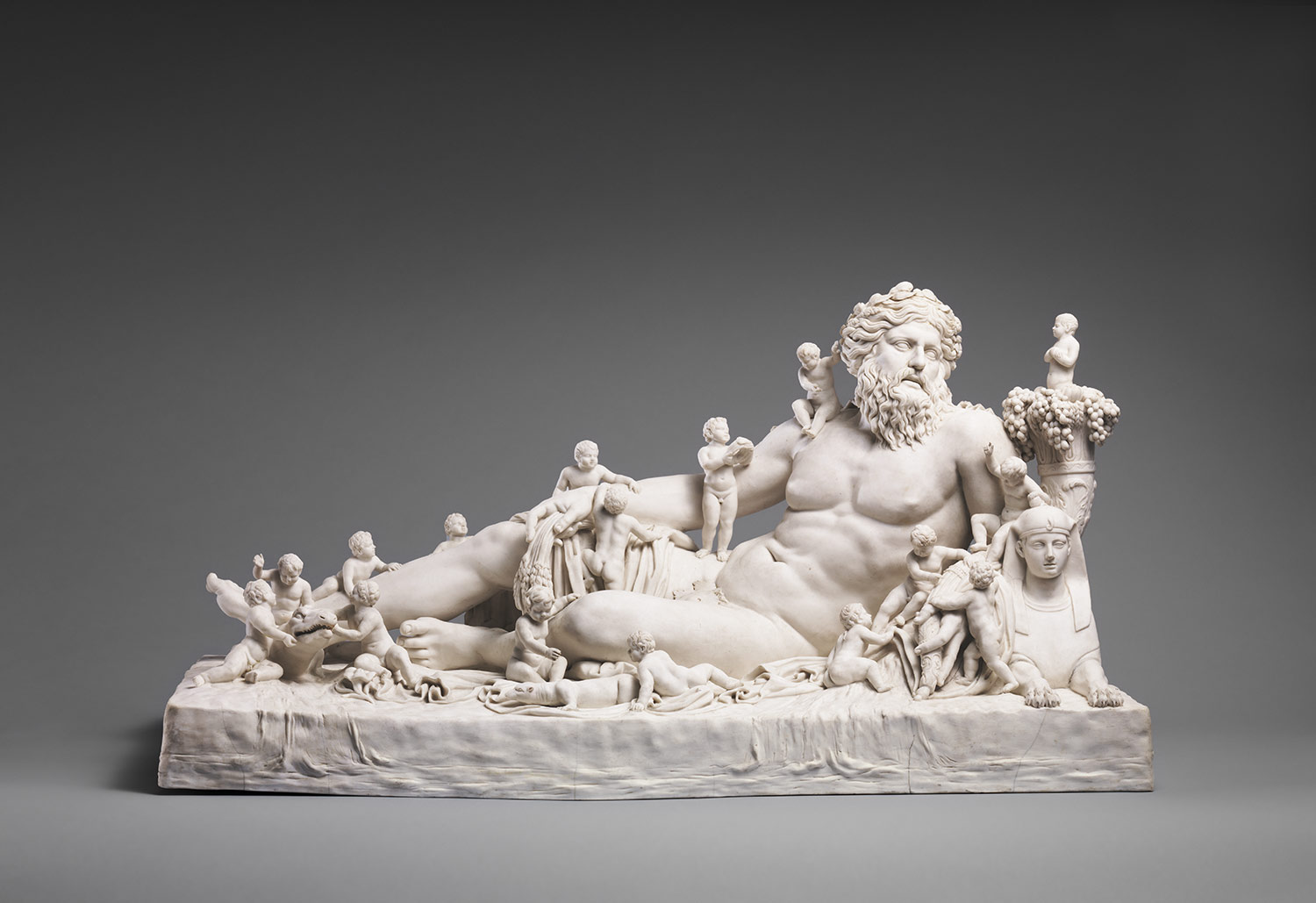
The River Nile, ca. 1740–95
Giovanni Volpato (Italian, ca. 1735–1803)

The Vatican Nile, itself a copy of a Hellenistic statue, probably Alexandrian in origin, was discovered in the early sixteenth century in excavations of the shrine to Isis and Serapis near Santa Maria sopra Minerva in Rome. Pliny the Elder mentions a similar sculpture in ancient Egypt in his Natural History (36.58), explaining that the babies surrounding the river god represent the ideal height of sixteen cubits to which the Nile river rose annually, thereby assuring abundant fertility in Lower Egypt. The Nile's waters, carved as wavy lines and embellished with ibisis, crocodiles, and hippopotami on the Vatican group, are more effectively replaced with wet drapery on the Volpato version due to its smaller size. The Neoclassical flavor of such drapery prefigures its later use by sculptors such as Canova.
The original, a colossal ancient Roman marble sculpture of the Nile, is housed in the Braccio Nuovo at the Vatican.
A cinquecento copy of the Vatican Nile once stood in the stairway at Monserrate. An early item in the Cook Collection, this sculpture once formed part of the Worsley collection. In the same hall there were Flemish Tapestries, Roman Busts, and a large Arabic oil jar.
Subscribe to:
Posts (Atom)

