Saturday, 10 January 2009
Etruscan Sarcophagus

Thursday, 1 January 2009
Tibouchina urvilleana
Infuriating nomenclatural history, far too many synonyms, often misidentified. Oates called it T. semidecandra. Hooker called it Pleroma Kunthianum. It was illustrated in Curtis's Botanical Magazine (4412) under this designation. (December of 1848) This species was introduced to Europe when raised from seeds received at Glasgow Botanic Garden (sent by Gardner when collecting in the Organ Mountains above 3000 ft.). Murray later sent seeds to Kew. Paxton in 1847 considered this to be a stove-shrub.
Trithrinax brasiliensis
Les Palmiers, Kerchove, Paris 1878
Trithrinax brasiliensis Mart.
Henderson, A., G. Galeano & R. Bernal 1995. Field Guide Palms Americas 1–352.
Trithrinax acanthocoma Drude (Gartenflora 27: 361. 1878)
Modern Botanists include T.acanthocoma within T. brasiliensis.
Still growing below the chapel as described by Walter Oates in 1929. For many years I overlooked this palm as a Trachycarpus (common throughout the garden). The spines within the fibrous trunk were concealed by ivy. These, along with the palms identity, were revealed in clearing works carried out in late 1990's.
Cette espèce, sans ètre commune, est encore une de celles dont l'habitation est très-étendue. Je l'ai vue sur deux points seulement : près du Rio Parana, un peu au-dessus de la Bajada, c'est-à-dire vers le 31.º degé de latitude sud. Elle croissant isolément au sommet des falaises de Féliciano, au milieu des broussailles, en des lieux très-secs. Comme tous les plants en étaient assez rabougris, je dus croire qu'elle se trouvait aux confins de sa zone d'habitation. Je l'ai retrouvée ensuite vers le 17.º degré de latitude, au sein de la grande forêt (Monte Grande) qui sépare santa-Cruz de la Sierra de la province de Chiquitos (Bolivia). Elle croit alors par bouquets et par bois, sur les lieux les plus élevés de l'immense plaine qui sépare le versant de l'Amazon de celui de la Plata. Elle se mêle souvant aux autres arbres, et specialment aux boissons; car je ne l'ai jamais rencontrée au sein de la forêt, quand celle-ci est composée de grands arbres.
Ses feuilles, cueillies avant leur épanouissement, servent à tresser des chapeaux assez estimés.
Les Espagnols du pays la nomment Saho, mot corrompu, sans doute, du nome de Utsaho, que lui donnent les Indiens Guarayos de la Bolivia. Les Chiquitos l'appellent dans leur langue, Huaichick.
Alcide d'Orbigny
Voyage dans l'Amérique Méridionale(le Brésil, la république orientale de l'Uruguay, la République argentine, la Patagonie, la république du Chili, la république de Bolivia, la république du Pérou), exécuté pendant les années 1826, 1827, 1828, 1829, 1830, 1831, 1832, et 1833,V.e Levrault, 1835-47.
Vol. 7 pt. 3, p. 44., Paris, Pitois-Levrault et c.e; Strasbourg, 1835-47
Wednesday, 31 December 2008
Exochorda racemosa

Sunday, 28 December 2008
Passiflora mollissima

Bot. Mag., Nº 4187
Passiflora mollissima
Bot. Reg. for 1846 plate 11
Paxton's Mag. of Bot., vol. xiii, p.25
Tacsonia " a genus of very ornamental climbing plants, with the habit of the Passion Flowers, but easily distinguished from them by the immense length of the tube of the calyx. The name Tacsonia is derived from that applied to one of the species in Peru. There are numerous species in the genus, but only two as yet have been introduced." Jane Loudon Ladies' Flower-garden of Ornamental Greenhouse Plants (1848).
The two species referred by Mrs. Loudon were Tacsonia pinnatistipula Juss. and Tacsonia mollissima H. B. et K. She describes the plant as "not so ornamental as T. pinnatistipula" though of similar growth and thriving best in a conservatory. A native of the tropics of New Granada, it grows at an altitude of nine to eleven thousand feet, thus suited to a temperate climate. When grown in a stove the blossoms fall off without expanding.
Found by Humboldt at santa Fè de Bogota, and Lobb in woods near Quito. Raised from seeds sent to Veitch at Exeter. (1844).
An important identifying characteristic of this species is the presence of 12 green glands which stud the purple petiole.

Photograph of genuine Passiflora mollissima from Mobot
The plant generally grown under this name in Portugal is a hybrid.
Synonyms
Murucuja mollissima Spreng. or Murucuia mollissima (Kunth) Spreng.
!Passiflora tomentosa Lam. invalid name
Passiflora tomentosa var. mollissima (Kunth) Triana & Planch.
Tacsonia mixta subsp. tomentosa (Cav.) Mast.
!Tacsonia mollissima Kunth invalid name
Tacsonia mollissima var. glabrescens Mast.
Hardenbergia comptoniana
Hardenbergia comptoniana Benth.
in Hueg. Enum 41.
Flora Australiensis, George Bentham (assisted by Ferdinand Mueller - govt. botanist, Melbourne, Victoria) London, 1864
West Australia. King Georg's Sound, R. Brown ; and thence to Swan River, Drimmond, 1st. collection and n. 271, Huegel, Preiss, n. 1093, 1094, and others.
Jardins de France (1857) "Hardenbergia Comptoniana Bth. Elle a été figurée dans le Botanical Register, tab. 290, sous le nome de Glycine Comptoniana, et elle est aussi connue des horticulteurs sous celui de Kennedya Comptoniana Link.
First classified as a Glycine (Wisteria) this vine was quickly transferred to Kennedya (under which name Walter Oates referred to it cautiously in his 1929 article). Grown as a glasshouse climber in Britain. Jane Loudon in her Ladies Flower-garden of Ornamental Greenhouse Plants (1848) calls it "one of the most common plants in greenhouses, as it is of remarkably easy culture". She gos on to state that "the plant is a native of the neighbourhood of Port Jackson, in New Holland, and it was introduced in 1803." She describes its "twining habit, and when planted in the free ground of a conservatory, it will grow to a considerable height."

From Paxton's Magazine 1841
The description that accompanies this illustration recommends this Hardenbergia for pot culture since in the glasshouse border it is apt to grow vigorously and flower only after it has reached considerable size. The example provided for the plate was grown on the estate of the quintessentially named Victorian gentleman: Sir Edmond Antrobus, Bart., at Cheam. His gardener was nicely named too: Mr. Green.
Hardenbergia macrophylla
Swan River Colony, West Australia. Introduced by Sir James Stirling, who sent seeds to England in 1835. Raised by Robert Mangles at Sunningdale, Berks. Flowered by Mr. Kyle gardener to R. Barclay of Layton Essex in May
Saturday, 27 December 2008
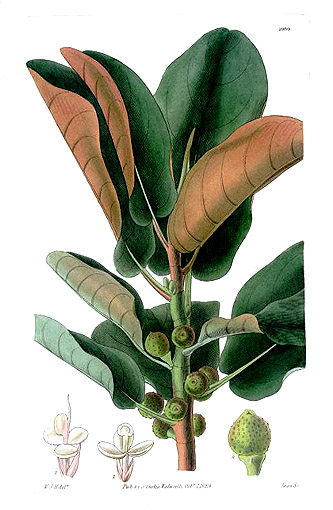
Ficus rubiginosa
Ficus rubiginosa Desf. ex Vent.
"A small tree in our stoves" begins the description in Curtis's Botanical Magazine. This is a monster at Monserrate. The description continues more true to form "throwing out many, spreading branches, and from the the stem and branches numerous woody roots, which reach the ground, like those of the famous Banyan, and give new support to those parts. Introduced by the Right Hon. Sir Joseph Banks, from New South Wales to the Royal gardens, whence it has been distributed, and is , we believe, now general in collections of stove plants. Its frutification is, however, of rare occurance. The specimen from which the accompanying figure was taken was sent by the Messrs. SHEPHERD, from the Liverpool Garden, in the summer of 1827."
Ficus rubiginosa occurs from north Queensland southwards along the eastern coastline of Australia to the vicinity of Bega on the South Coast of New South Wales. It is found on the edges of rainforest and gullies and rocky hillsides. (Wikipedia)
There has been some confusion over the naming of this fig with Ficus macrophylla, a related though far larger tree that lacks aerial roots and the rusty indumentum. Ficus macrophylla in Southern Europe is often designated Ficus magnolioides Borzi (invalid synonym of Ficus macrocarpa subsp. columnaris). It is easy to see why Ficus magnolioides should be transferred to Ficus rubiginosa trees in error - to the unwary the large glossy leaves and rusty undersides of Ficus rubiginosa do look somewhat like a Magnolia .
There is a magnificent specimen of Ficus macrophylla subsp. columnaris at the Palermo Botanic garden It was planted in 1845 by Vincenzo Tineo (1791-1856). He was director of the Orto botanico di Palermo from 1814 until 1856. The tree was brought from Norfolk Island. This was Borzi's type specimen for his Ficus magnolioides.
Saturday, 20 December 2008
Chapel